


Do I Want to Make It in the Art World, or Do I Want to Do It Differently?

Updated: 4 hours ago
On Sunday, I spent an afternoon at The Other Art Fair in London. This time, I was there as a visitor rather than an exhibiting artist.
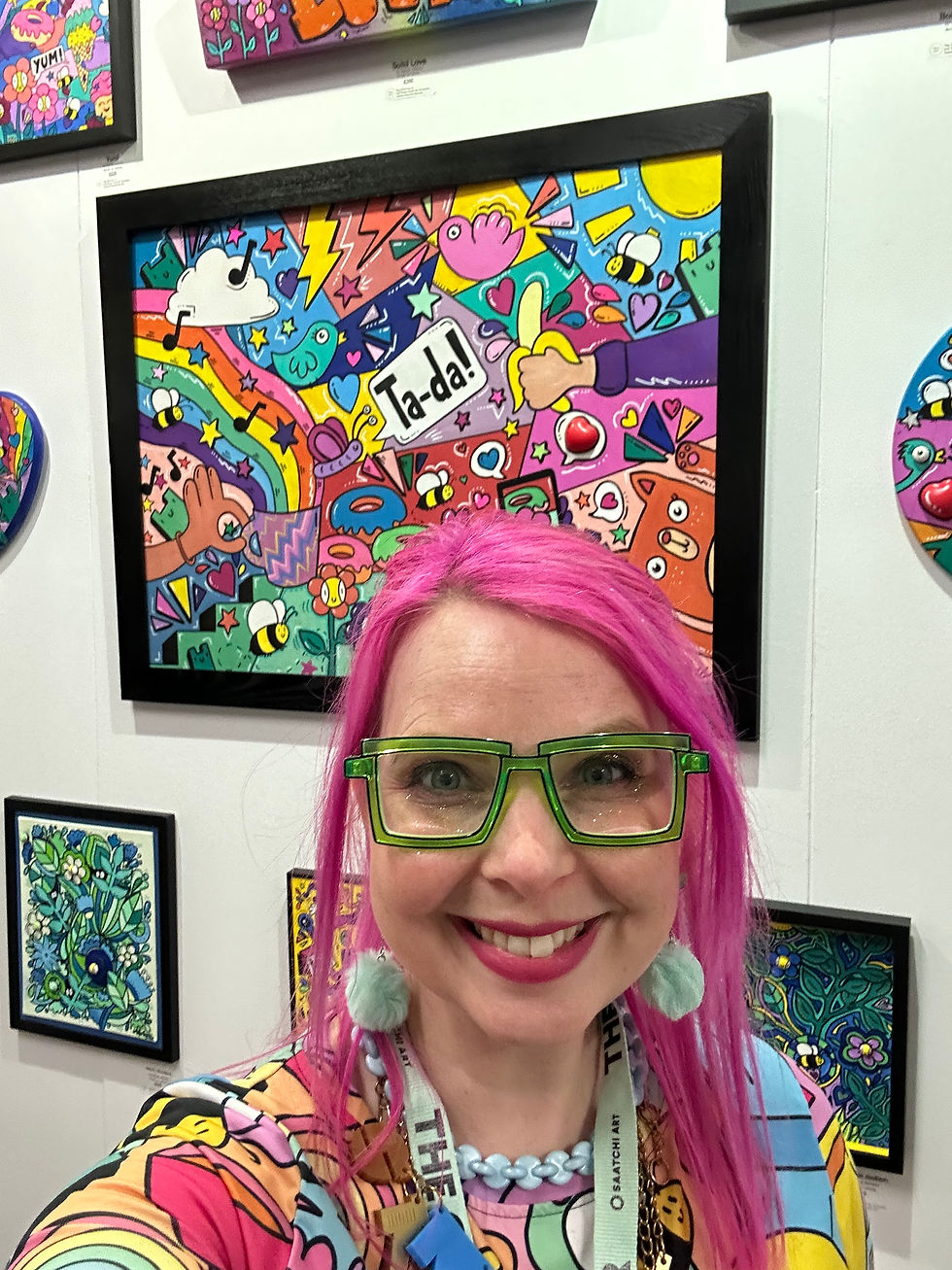
Back in March, I had my first booth at the fair. Having experienced it from the other side of the stand, I was curious to return in October and see it through a different lens. What had I learnt from exhibiting? What did I notice now that I wasn’t worrying about my own artwork, talking to potential buyers or wondering whether I’d remembered to bring enough business cards?
More than anything, I found myself thinking about where I want to take my art practice and what it means to build a sustainable career as an artist.
Because the truth is, I have lots of questions about what comes next.
The financial reality of being an artist
Exhibiting at an art fair involves a significant investment of time, money and creative energy. There’s the cost of the booth, the materials, the work you need to create, the transport and all the other expenses that inevitably crop up. And then there’s the time spent preparing everything, setting up and being there for the duration of the event.
It’s an investment in your future as an artist, but one that comes with uncertainty. There’s no guarantee that you’ll sell enough work to cover your costs, let alone make a profit.
I know this particularly well because I run a successful creative business, Sketchnotes UK. I’ve worked out how to make a living from turning complex ideas into simple, beautiful visual stories. If money were my only motivation, I’d spend all my time doing that.
But there’s something inside me that wants to make art that is entirely my own.
I love working on commissioned paintings and murals, but what really excites me is creating something that starts with an idea of my own, inspired by the world around me, the things I notice and the conversations I have. Work where I’m not following a brief or trying to meet someone else’s expectations. Work where I’m the ultimate decision-maker, from the first idea to deciding when a piece is finished.
I don’t just want to make a living from being creative. I want to build a life as an artist.
And there’s a rather significant problem with that ambition: I’ve figured out how to make my creative business financially viable, but I haven’t yet figured out how to make my art practice financially viable.
My sketchnoting business currently enables me to pursue my art, but I can’t rely on it to subsidise my artistic ambitions indefinitely. I have household bills to contribute to, and financial security matters.
So how do I make this work? How do I invest in my future as an artist without taking financial risks I can’t afford?
Finding strength in numbers
Recently, I’ve been exploring some of these questions with four other artists. Together, we’ve formed JoyBeam Art Collective, and earlier this month we held our Floral Stories exhibition in a private gallery in Marylebone.
Once again, there was a financial risk involved. But this time, we shared the costs.
We also deliberately chose a location where we hoped to encounter people with disposable income. Our gallery was next to a human spa and, wonderfully, a doggy spa. We spent the week watching an endless procession of very pampered dogs arriving for their appointments and leaving with what appeared to be better blow-dries than most humans ever experience.
I can only imagine what their spa treatments cost!
As a collective, we covered our costs and made a small profit. But selling artwork wasn’t our only objective. We wanted to establish ourselves as a group of talented emerging artists who deserve to be part of the wider art scene, including the London art fairs that can sometimes be difficult to access without gallery representation or an established collective.
We’re now planning to spend time agreeing on our shared three-to-five-year vision and working backwards to identify the steps we need to take to get there.
And that’s made me think about my own trajectory. Where do I want to be in three to five years? What do I want my art practice to look like? And what do I need to do to get there, both with the collective and independently?
Returning to The Other Art Fair was part of that exploration.
What makes people buy art?
Walking around the fair on Sunday, I saw some beautiful work and had some brilliant conversations with talented artists. Some appeared to have sold a great deal of their work, while others seemed to have had a quieter experience.
I found myself wondering what makes the difference.
Of course, there are countless factors involved in selling art: the work itself, the price, the presentation, the audience and the connections people make with individual pieces. And there’s the conversation between artist and buyer, too.
I’ve held sales roles in the past, and I know I’m good at selling other people’s products. But selling my own work feels different. I’m not sure whether I can do it consistently without it taking an enormous amount of energy.
Back in March, I experienced quite a lot of imposter syndrome. I questioned whether I belonged there and whether my work was good enough to stand alongside everything around me.
I still don’t know whether selling art is a skill I need to develop or whether I need to explore different ways of connecting with people who might love my work.
And then I remembered somewhere I’d felt completely different.
The place where I didn’t feel like an imposter
The Truman Brewery, where The Other Art Fair takes place, is also home to the London Coffee Festival.
The first time I went there was because a sketchnoting client had commissioned me to create illustrations for their stand. I don’t even drink coffee, so I’d planned to pop in, take a few photographs and leave.
Instead, I stayed all day. The atmosphere was infectious.
While I was there, I discovered that the festival had an artist in residence each year. At the time, I was reluctant to put myself forward for opportunities because I wasn’t confident that my mental health could cope with rejection. But something made me reach out and ask about the selection process.
Before I knew it, I’d been chosen as the London Coffee Festival artist in residence for 2025.
It was extraordinary.
I sold almost every original painting I’d brought with me, sold more prints than I’d imagined possible and completely sold out of the T-shirts I’d designed for the festival.
I also designed a mural behind the DJ booth and created a live mural, incorporating visitors’ requests into my drawings as they watched me work.

I had the time of my life.
But what stays with me most isn’t how much I sold. It’s that I didn’t feel like an imposter.
I was proud to be there. I was proud of my work. I felt as though I belonged.
Perhaps that was partly because I wasn’t comparing myself with other artists in quite the same way. Perhaps it was the festival’s atmosphere, with thousands of people enjoying themselves. Or perhaps I was simply in an environment that suited me.
The London Coffee Festival attracts around 22,000 visitors over four days, and it’s a very different experience from an art fair. People are buzzing with excitement (and caffeine!), the atmosphere is lively, and there’s so much happening around you.
I also made considerably more money selling my work there than I did at The Other Art Fair.
It’s difficult to separate those things. Was I happier because I sold more? Did I sell more because the environment was right for me? Or was it a combination of all of them?
I genuinely don’t know.
But I do know that the experience showed me what was possible when I found the right setting for my work.
A very different kind of creative inspiration
After leaving The Other Art Fair on Sunday, I headed to one of Brick Lane’s brilliant markets.
I knew exactly where I was going. There was a stall I wanted to find, run by a very talented artist whose shop is called Bitch Kitsch London. He makes some of the craziest earrings I’ve ever seen, often using children’s toys.
If you’ve ever met me, you’ll know that earrings are a staple part of almost every outfit I wear. I feel practically naked without them, and as far as I’m concerned, the bigger the better.
But it wasn’t just the earrings that drew me in. It was the stall itself.
I’d gone from the carefully curated displays of an art fair to a market stall crammed with colourful, wonderfully bonkers creations. Nothing was given space to breathe. Everything was competing for attention.
And I absolutely loved it.
It was a full-on, childish dopamine hit of colour. I could happily have stayed there all day.
In fact, I wish the entire stall could be my walk-in wardrobe. The sort I dream of having in the house I know I’ll never be able to afford. But that’s another story.
I could also imagine the joy involved in creating that collection. The hunting for materials, the unexpected discoveries, the transformation of ordinary objects into something completely different.
It reminded me of why I love charity shops and creative recycling spaces so much. The excitement of finding something unexpected and imagining what it could become.
And I found myself wondering whether this kind of creative freedom is closer to what I want to explore in my own work.
Do I need to find a different path?
Here’s the thing. I want to build a successful career in the art world. I want people to buy my work, recognise my style and give me opportunities to create bigger, bolder and more ambitious things.
I want to create immersive experiences that make people feel as though they’ve stepped into a different world. Spaces bursting with colour, playfulness and joy. Artwork that provokes an emotional response rather than simply looking nice on a wall.
But I’m questioning what route will help me get there.
Traditional art fairs could absolutely be part of that journey. So could exhibitions, collaborations, public art projects and opportunities in unexpected places. I’m interested in exploring all of them and learning where my work connects most strongly with people.
I don’t know whether I sometimes feel uncomfortable in more traditional art environments because of imposter syndrome, or whether I’m still discovering the spaces in which my particular approach to art can thrive.
Perhaps I need to build my confidence and learn to sell my work more effectively. Perhaps I need to keep exhibiting at established art fairs and accept that building an artistic career takes time.
Or perhaps I need to experiment with some less conventional approaches, too.
Maybe there are artists who’ve already carved out a path that looks more like the one I’m imagining. Maybe I need to seek them out, learn from them and see what I can take from their experiences.
Or maybe I need to create a new path for myself.
I don’t have the answers yet. But I know that I don’t want to spend the next five years trying to become a version of an artist I’m not, simply because I think that’s what success is supposed to look like.
I want to build a sustainable art practice that allows me to make the work I care about, earn a living and bring a little more colour and joy into the world.
And if that means doing things differently, then perhaps that’s exactly what I need to explore.
For now, I’m going to keep asking questions, experimenting and paying attention to the places where I feel most creatively alive.
Because maybe the question isn’t whether I belong in the art world.
Maybe it’s about discovering where my work can have the greatest impact, and remaining open to all the different ways I might get there.


Comments